Community consultation, done properly
Structured consultation, exhibition materials and response discipline: how councils gathered views they could defend.
The Common Ground editorial deskPublished 5 min read
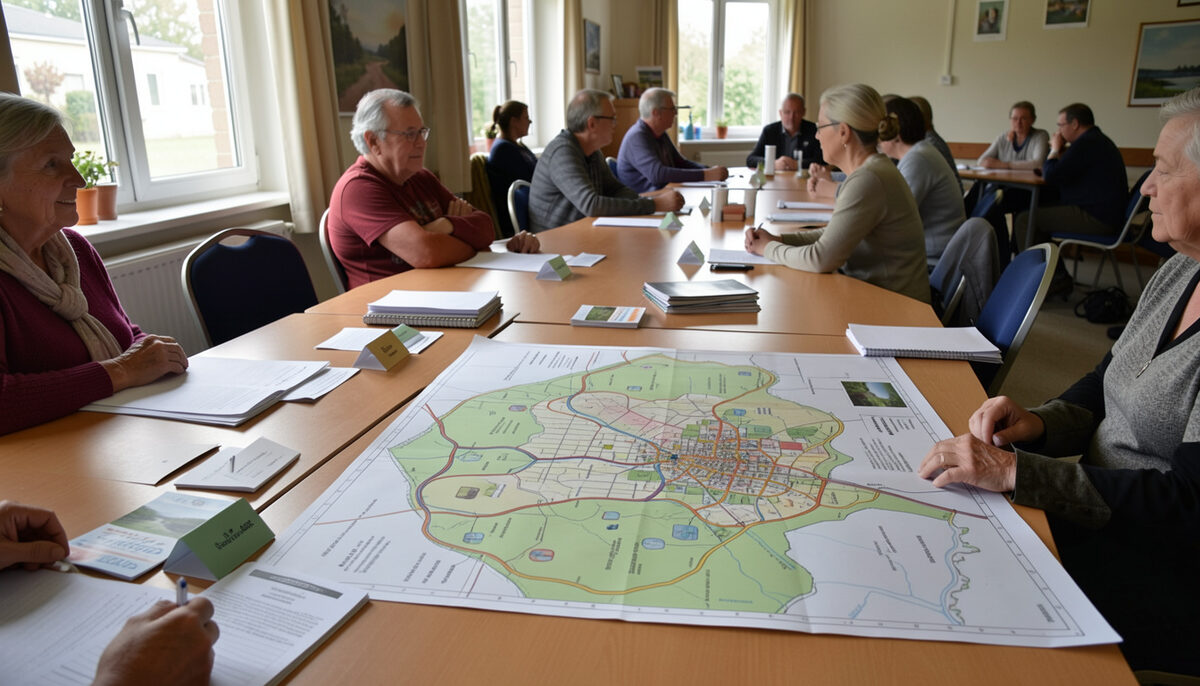
Consultation has become a standard expectation in planning and leisure work, but the gap between a consultation exercise and a meaningful one is wide. The archived practice of Ashley Godfrey Associates, drawn from project records and testimony including work in South Gloucestershire, offers a picture of how consultation was actually delivered: designed programmes rather than open invitations, materials built to aid public understanding, high volumes of reliable information, and community support used as cover for decisions rather than as decoration after them.
Programmes designed for wide participation
The starting point in the archived practice is that consultation is not a single event but a designed programme. The firm's documented toolkit combines quantitative methods, such as postal surveys, online surveys and self-completion forms, with qualitative work including focus groups and workshops. These are not alternatives but complements: the quantitative strand produces numbers that can be compared between different groups of people, while the qualitative strand explores why those patterns exist.
Crucially, the methods were adapted for groups that do not normally respond to standard tactics. Work with children illustrates this directly. Ashley Godfrey Associates worked with Bristol City Council to develop a play questionnaire designed for completion by children themselves, and undertook focused consultation exercises with children and young people to support the development of play strategies. A questionnaire written for adult respondents would have excluded precisely the population whose play provision was at stake; designing the instrument for the respondent, rather than the analyst, is a method, not a promise.
Response rates matter as evidence of whether a programme worked. The practice recorded response levels of 35% or more on a 12-page postal survey, and treated such levels as achievable rather than exceptional. A long questionnaire is a demanding format, and getting a substantial proportion of a community to complete one indicates that the design, distribution and follow-up were planned as a whole.
Materials that aid understanding
Participation depends on people understanding what is being asked of them. In workshop settings, the archived practice describes group tasks that were entertaining but strongly relevant, used to draw out views from all group members, including the less articulate. Facilitation was treated as a skill: facilitators led groups through a programme structured to ensure that every member could contribute, not only the confident speakers.
This reflects a broader principle visible across the practice. Whether the subject was children's play provision or open space assessment, the material placed in front of the public had to be intelligible to non-specialists. Questions about play space quality, access and usage were translated into forms that a child, a parent or a parish councillor could engage with directly. The rigour sat in the design and analysis, carried out by a specialist associate with long-standing expertise in survey design, not in technical language pushed onto respondents.
High-volume, reliable information
Consultation in this practice sat alongside, and was checked against, hard evidence about provision on the ground. Detailed audits of provision for children and young people were undertaken to assess the quality of existing facilities and identify priorities for improvement. The firm also worked with Fields in Trust on national benchmarks for different types of play space, giving local authorities a reliable point of reference when setting their own locally-determined provision standards. Similar benchmark thinking informed work on the Fields in Trust benchmarks more generally.
The volume of information mattered as well as its reliability. A consultation response can only be interpreted properly when set against a full picture of what exists: how many sites, of what quality, serving which catchments. The practice of surveys and audits of local provision and of mapping open space and catchments supplied that picture. When residents said provision was poor, or sufficient, the audit allowed the claim to be tested rather than simply recorded. This is what gives consultation findings weight in later decisions.
Community support as decision cover
The South Gloucestershire testimony pattern points to a further, less often stated function of consultation done properly: community support provides cover for decisions. When a local authority can demonstrate that it consulted rigorously, that responses were analysed robustly, and that the resulting strategy reflects an evidenced balance of views, the eventual decision is defensible. Councillors and officers can point to a documented process, not to professional judgement alone.
This is not consultation as box-ticking. The cover only holds if the process beneath it is sound, which is why the practice insisted on consultation being rigorous, meaningful and inclusive as the archived material puts it. Workshops were run not only with members of the public but with stakeholder interests and even elected members, so that the decision-makers themselves were part of the process of weighing evidence. A decision preceded by that kind of engagement is harder to challenge, and challenges that do arise can be answered with the record.
Methods, not promises
What distinguishes this archived practice is that every claim about consultation reduces to a describable method: a questionnaire designed for children; a 12-page postal survey achieving high response rates; group tasks structured to include quiet participants; audits and benchmarks that anchor opinion in evidence; facilitation programmes that ensure inclusion. None of these depend on goodwill or aspiration. They depend on design, specialist skill in survey analysis, and a willingness to adapt instruments to the people being asked.
The same discipline appears elsewhere in the practice, from play provision and playing pitches to performance management, where indicators developed with Play England and the Department for Culture, Media and Sport provided a robust way to assess whether authorities were delivering inclusive and accessible free local play space. Assessment and consultation belong to the same family: both turn local experience into evidence that decisions can rest on.
Public bodies remain bound by wider expectations of good consultation, set out in the government's consultation principles guidance. The archived practice described here shows what meeting those expectations looked like in concrete terms: programmes designed for participation, materials people could understand, information in volume that could be trusted, and communities whose documented views gave decisions their cover. For more on the broader tradition behind this work, see the craft of planning practice.