Play provision and playing pitches
Play strategies, Fields in Trust benchmarks and playing pitch strategies: planning space for children and sport.
Play and sport occupy a distinctive corner of planning practice. Unlike housing or highways, their value is measured less in units delivered than in the quality of opportunity they afford: whether a child can reach a decent play space on foot, whether a junior football club can secure a pitch on a Saturday morning, whether provision is distributed fairly across a district. That makes the evidence base unusually important, and it has given rise to a recognisable craft of its own, built around audits, benchmarks, and demand assessments.
This article sets out the main components of that craft: the audit of existing play provision, the guidance developed by Play England, the benchmark standards published by Fields in Trust, and the playing pitch methodology pioneered by Sport England. Together they form the working toolkit of most open space and recreation strategies prepared in England today. For the background to this body of work, see the consultancy behind this address, whose principal, Ashley Godfrey, played a direct part in developing several of these national instruments.
Auditing what already exists
Every strategy begins with an audit. In the case of children's play, an audit records each site, its size and location, the equipment and features it offers, its condition, and its accessibility: can a child reach it without crossing a main road, is it enclosed, does it cater for a range of ages including teenagers. The purpose is not simply to compile an inventory but to build a picture of quality and distribution, so that gaps in provision and priorities for investment can be identified systematically rather than anecdotally.
Audits gain their value when combined with consultation. Children and young people are the users of play space, but they are among the groups least likely to respond to standard consultation tactics. Focused exercises, including questionnaires designed specifically for completion by children, have been used to support play strategies, alongside the range of methods described in community consultation, done properly. The audits themselves form part of a wider family of provision surveys, described in surveys and audits of local provision, and the results are typically plotted geographically so that catchments and deficiencies can be seen at a glance, as explained in mapping open space and catchments.
Play England guidance and the national play indicators
Strategic play planning in England received a significant push in the 2000s. The Department for Culture, Media and Sport and Play England commissioned work on Performance Indicators for Children's Play, intended to provide a robust assessment of the extent to which local authorities were providing children and young people with good, inclusive and accessible free local play spaces, services and facilities. Ashley Godfrey Associates worked with Play England and the Department on the development of these indicators.
Ashley Godfrey was also a member of the advisory group for the preparation of Planning for Play, the Play England guidance on the preparation of play strategies. The guidance reflected a settled view of what a play strategy should contain: an audit of provision, an understanding of demand drawn from population data and consultation, locally determined standards, and an investment and management framework. Alongside this national work, the consultancy supported Haki Kapasi in developing the Quality Assessment Tool for play, and worked with Bristol City Council on a play questionnaire for completion by children. The broader context for this work, including the CABE Space Children's Play programme of that period, is traced in how children's play provision is assessed.
Fields in Trust benchmarks
Local standards need a point of reference. Fields in Trust, formerly known as the National Playing Fields Association, has long published guidance on quantity, and Ashley Godfrey Associates worked with the organisation on the development of national benchmarks for different types of play space. These benchmarks give local authorities a reliable point of reference when developing their own locally determined provision standards, in the manner expected by planning policy since the days of PPG17 and continued under the NPPF, a transition described in from PPG17 to the NPPF.
- Benchmarks are a reference, not a rule. They allow a council to compare its own provision against national practice while setting standards that respond to local circumstances, demography and geography.
- Different types of space are benchmarked separately. Equipped play areas, informal play space, and provision for older children and young people each raise distinct questions of quantity, quality and accessibility.
- Benchmarks feed directly into development management. Once adopted, local standards inform negotiation over open space contributions on new development. The detail is set out in the Fields in Trust benchmarks.
Playing pitch strategies and the Sport England methodology
Pitch sport demands a different analytical approach, because the unit of demand is the team rather than the individual visit. Sport England's assessment guidance and toolkit, Towards a Level Playing Field, was published in 2003, and Ashley Godfrey was the Project Leader for its development. Since publication, this tried and tested methodology has been employed across the country in the preparation of playing pitch strategies and has become the recognised approach to quality and quantity appraisal. The methodology is described in detail in how a playing pitch strategy is built, and Sport England's current guidance is published at sportengland.org.
The robustness of a playing pitch strategy depends on the quality and detail of information about usage and demand from football, cricket, rugby and hockey teams, information which can be notoriously difficult to secure. Surveys in this area undertaken by the consultancy have consistently achieved response rates in excess of 90 per cent, well above the return rates common in the field. The team-based demand model is then matched against an audit of supply: detailed quality assessments of pitches, using criteria developed from the Performance Quality Standard and adapted to demanding standards of work. Beyond pitch sports, the same strategic approach extends to other outdoor sports including bowls and tennis, and to assessments of indoor facilities. Completed studies include playing pitch assessments and strategies for Nottingham City Council, Thurrock Council, Middlesbrough Council and the London Borough of Brent.
A craft of evidence
What links play provision and playing pitches is a shared reliance on evidence gathered patiently: audits walked site by site, questionnaires returned by club secretaries and by children, catchments drawn on maps. The national instruments described here, the play indicators, the Play England guidance, the Fields in Trust benchmarks and the Sport England toolkit, were all built on that same patient work, and they continue to shape how councils plan for play and sport. The wider setting of open space assessment, from PPG17 onwards, is covered in how a PPG17 open space assessment worked and in parks and open space, planned properly.
All pieces
4 pieces-
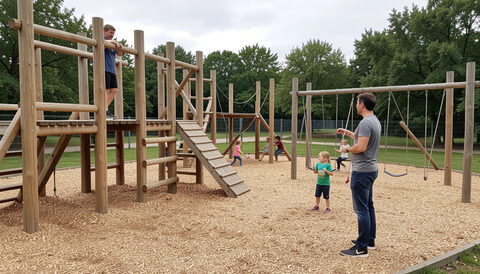
How children's play provision is assessed
Play England indicators, Fields in Trust benchmarks and play strategies: what good local play provision looked like.
Read the piece -
How a playing pitch strategy is built
Auditing every pitch, asking every club, modelling demand: what a playing pitch strategy proves and how it is used.
Read the piece -
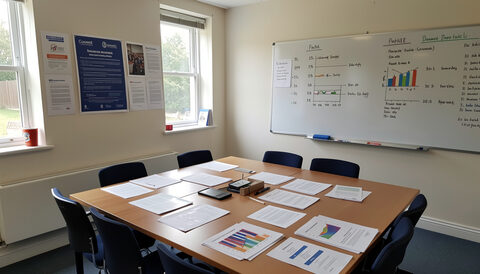
Performance management in practice
Indicators, targets and inspection: how councils measured whether park and play services actually improved.
Read the piece -
The Fields in Trust benchmarks
Six acres per thousand people, play space typologies and local standards: where the famous benchmarks came from.
Read the piece